Understanding where you are
The Personal Development Map is the report produced from your responses to the Personal Development Mapper. It offers a way to reflect on your experience, recognise the strengths you can draw on, and explore what may need attention in your life now.
You may feel capable and settled in some areas while finding others more difficult. Perhaps you understand your feelings but struggle to express what you need. You may care deeply for others and find it harder to give yourself the same care. Or you may sense that something is changing, while your next steps are still taking shape.
The Map brings these different aspects of your experience together, helping you consider how they relate to one another and where you might begin.
Seeing the connections
Grounded in psychosynthesis, the Map explores your relationship with your thoughts and feelings, different parts of yourself, your choices and relationships, and your sense of meaning and direction.
Looking at these areas together can help you recognise familiar patterns. You might notice, for example, that reflection comes readily to you, while putting an insight into practice takes more effort. Or that you feel a strong sense of purpose but have little space to attend to your emotional needs.
These connections can offer a fuller understanding of a difficulty, alongside the qualities that may help you work with it.
Appreciating what has supported you
The ways you have learned to meet life deserve thoughtful consideration. Independence, sensitivity, determination or a capacity to care for others may have helped you through demanding experiences. As your circumstances change, you may find that you need a different balance between these qualities.
The Map encourages you to recognise what is already available to you. Your ability to reflect, seek support, stay with uncertainty or act on something that matters can provide a foundation for further development.
Areas that feel difficult also deserve care. Understanding them involves taking account of your history, relationships and present circumstances. A questionnaire can offer a starting point; your own experience brings the depth and context.
Finding a focus
Your results may highlight themes that seem particularly relevant at this point in your life. These might include making more room for your feelings, developing confidence in your choices, understanding your inner critic, or exploring a changing sense of purpose.
You can take time to consider what feels useful and choose a manageable place to begin. A small shift in something that matters to you may be enough to open up further possibilities.
Your report offers developmental feedback and questions for reflection. AI helps prepare the draft, and I review every report before it is sent. Depending on your responses and the review, a report may be withheld.
See an example of your Development Map
This fictional example gives you a sense of what your report might include: a reflection on strengths and patterns, suggested practices, a manageable four-week plan and links to relevant workbooks. Alex and the responses used to create this example are entirely invented. Your own Map will reflect your responses.
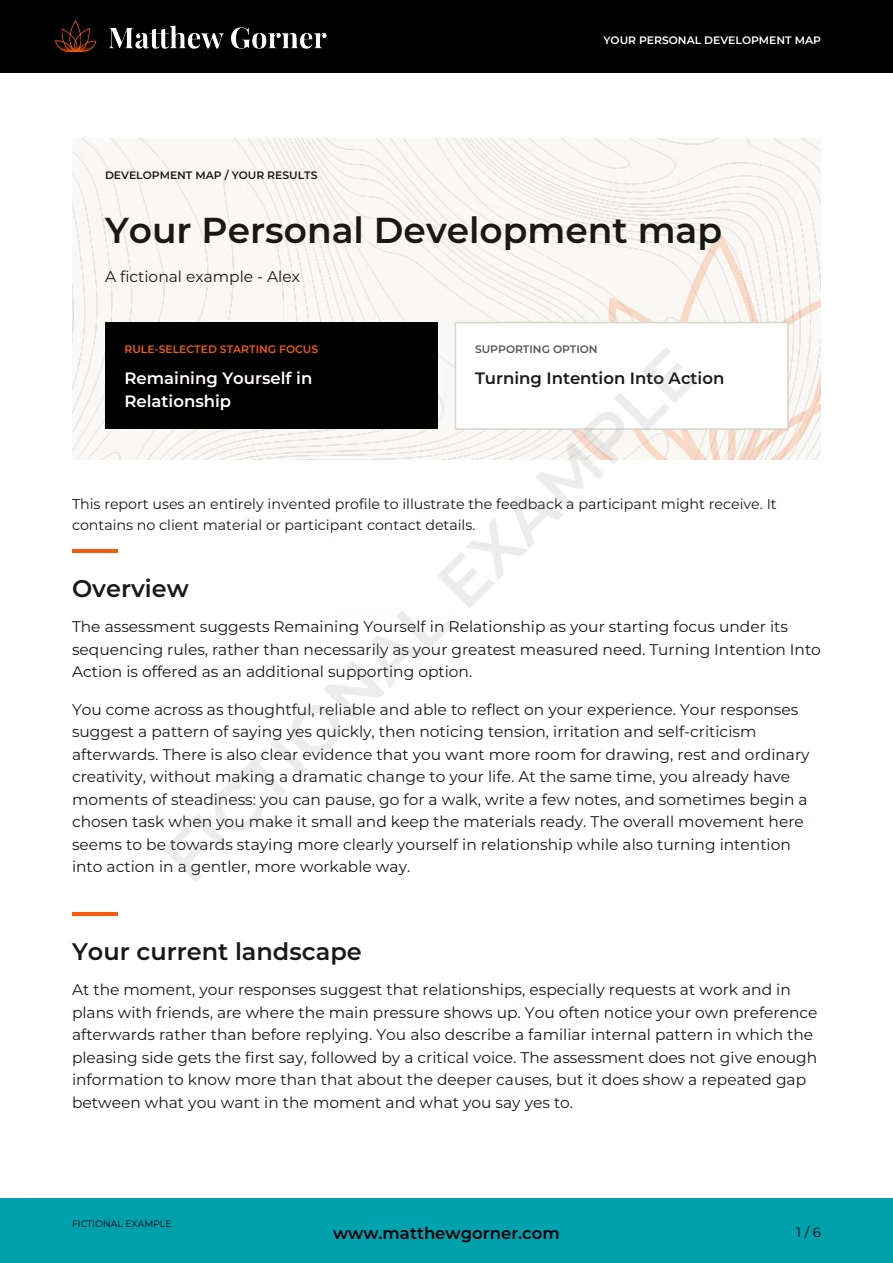
View the example Development Map (PDF)
Taking your next steps
Your Map can help you find a direction through the reflections, exercises and resources within the Psychosynthesis Journey.
You might choose to explore an exercise, spend time with a question, or discuss something you have noticed with someone you trust. There is room to work at a pace that suits your circumstances and to return to a theme when you feel ready.
As you read your results, you might ask:
- What feels familiar or helpful?
- What needs more context, or does not fit my experience?
- Which strengths could support me now?
- What would I like to explore further?
Using the Map on your own or alongside therapy
You can use the Map independently, and you do not need to be in therapy to benefit from reflecting on it. It can also be a useful companion to professional guidance, giving you and your therapist something concrete to explore together.
At the beginning of therapy, your Map may help you put words to what has brought you there, recognise what matters most to you, and agree where to focus your work. Returning to it at points along the way can support a conversation about your progress: what feels different, which patterns have shifted, and where you would like further support. Your responses can help you notice changes over time, alongside your own experience and the understanding you develop with your therapist.
If you would like to explore your Map with me, I offer psychosynthesis psychotherapy. We can consider your results in the context of your life and use them to help shape our work together. You are welcome to get in touch to discuss what you are looking for and whether working together might suit you.
A map for this moment
Your experience and priorities will change over time. Relationships, loss, work, creativity and other life events may bring different questions into focus. Your Map offers a picture of your responses at a particular moment, which you can reflect on alongside what is happening in your life.
The Map is a self-reflection tool, not a diagnosis, psychotherapy or a crisis service. Its results are intended to support your understanding and choices; they do not establish a level of psychological maturity or progress.